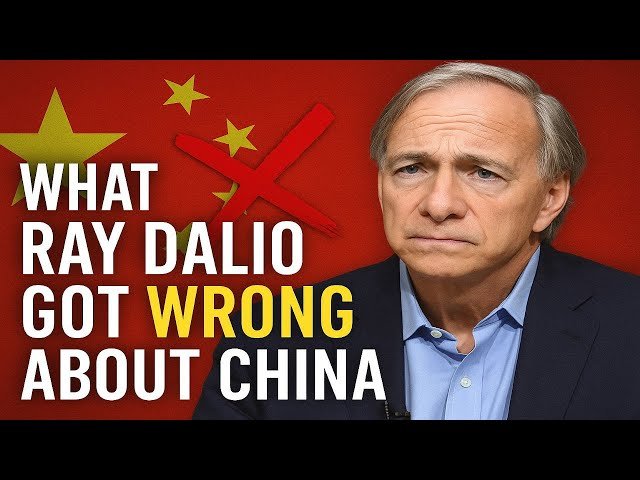
Hi everyone, welcome back to the channel. Today we are diving deep into a topic that’s been debated, dissected, and misunderstood for years. And at the center of it is one of the world’s most well-known investors, Ray Dalio. You probably know Ray Dalio as the founder of Bridgewater Associates, the world’s largest hatch fund, a brilliant macro thinker, a man with unmatched influence in global financial circles. But in recent years, Dalio has become one of the most vocal and passionate defenders of China’s long-term potential.
He has written articles, given interviews, and even published books suggesting that China is rising while the West is declining. that the Chinese system is efficient, meritocratic and future ready, that the West, particularly the US, should learn from China and not the other way around. But is that perception actually true? In this video, we’re going to break down exactly what Ray Dalio got wrong about China. We’re going to look at what he has said over the years and why the assumptions behind his views are simply not true.
The reality on the ground and what it all means for investors, policy makers, and global citizens trying to understand China today. So, grab a coffee, settle in, and let’s dig into what Ray Dalio got wrong and why it matters more than ever. Let’s begin by understanding Ray Dalio’s core argument about China. It goes something like this. China is experiencing a long time rise.
Much like the previous global powers such as the British Empire and the United States during their ascendancy, the US or more broadly the West is entering a period of decline marked by political dysfunction, debt, and social division. Dalio believes that China’s rise is inevitable due to its strong and wise leadership, efficient bureaucracy, its focus on education and infrastructure, strategic long-term planning and a confusion culture that promotes discipline, order and meritocracy. He often praises the Chinese Communist Party for being pragmatic, uh, resultsoriented and capable of adapting quickly to new challenges.
He has compared Xi Jinping’s government to a group of uh, capable CEOs running the world’s most complex enterprise. He argues that western democracies by contrast are chaotic, shortsighted, and constrained by messy political systems. Dalio also points to China’s economic record over the past 40 years, lifting hundreds of millions out of poverty, building worldclass infrastructure, and in a process becoming a tech powerhouse. as evidence that the system works and will continue to work.
Sounds compelling, right? But here’s the problem. Much of this argument is based on surface level observations, selective data, and a deep misunderstanding of China’s internal contradictions. Let’s unpack them one by one. One of Darlio’s biggest mistakes is equating authoritarian control with competence. Yes, the Chinese Communist Party can mobilize resources quickly. Yes, it can impose policies from the top down without going through elections or messy debates.
But control does not mean wise decision. Take CO zero for example. Dalio praised China’s response in 2020 as efficient and decisive. But what happened in the wrong run? The government locked down entire cities for months, banned travel and forced millions into quarantine camps. It refused import western vaccines for nationalist reasons. And when the policy inevitably collapsed, it was abandoned overnight with no plan, no preparation, and no transparency. Hospitals were overwhelmed.
And the real death toll to this day was likely in the millions, far higher than the government had admitted. That’s not competence. That’s rigidity followed by chaos. Dalio ignored the cost of control, focusing only on the temporary appearance of order and efficiency. The same goes for other areas from tech crackdowns to property market interventions. The Chinese government often looks decisive from the outside, but the costs of these decisions, including stifle innovation, capital flight, and collapsing confidence, are rarely accounted for in Dalio’s analysis.
Dalio also repeatedly downplays political risk in China, especially under Xiinping. He claims the leadership is rational, wise, and focused on outcomes. But this ignores one of the most important shifts in modern Chinese history. The centralization of power around the single man. Under she, China has become far more autocratic, opaque, and ideological. The days of collective leadership are over. Today, decisions are made in secret by a small circle of Xiinping’s royalists. Consider these examples.
The sudden disappearance of Jackmar, the overnight destruction of the afterchool tutoring sector, the forced detention of top executives, the suppression of all dissenting voices within the party and the media. These are not signs of a healthy rational system. They are signs of deep insecurity and overreach. Dalian has repeatedly said that we should not criticize the Chinese government because we don’t understand how it works, right? They’re just some like strict parents. But this is not intellectual humility.
It’s wishful blindness. Understanding political risk is essential for investors and policy makers and under she the risks are rising not falling. Dalio often praises China for allowing capitalism with Chinese characteristics. He sees the country as a place where entrepreneurship can flourish within limits under the wise guidance of the state. But here’s the truth. The private sector in China is under unprecedented pressure. Look at all the capital flight. Over the past few years, we have seen tech giants like Alibaba, Tencent, and DD targeted by regulatory crackdowns.
Entire industries like online education and fintech destroyed overnight. foreign investors pulling out due to a lack of transparency and arbitrary rules. Why? Because the party has decided that ideological control matters more than economic dynamism in today’s China. Shiing has made it clear the private sector exists to serve the party’s goals, not the other way around. Chinese entrepreneurs must tow the party line.
Innovation must align with state priorities and foreign investors must accept that the rules in China can change any time without prior notice and without legal recourse. Dalio’s failure to account for this has led him to overestimate China’s long-term potential and underestimate the risks to innovation, capital formation, and sustained growth. One of the other most glaring blind spots in Dalio’s China analysis is demographics. China is facing the steepest population decline of any major economy in history.
The birth rate has collapsed to record lows. The population is aging rapidly. The working age population is shrinking. Women are opting out of marriage and child birth in massive numbers. The 2023 census showed China’s population shrinking for the first time in decades, and this decline is only accelerating. It has enormous implications. A smaller labor force means slower growth. An older population means higher social spending and less productivity. Urbanization has peaked and the property market is in long-term decline.
Dalio barely acknowledges these issues. And when he does, he assumes that the wise leadership in China will figure it out. But the truth is they still haven’t. Government efforts to boost fertility from propaganda to subsidies to moral pressure have all failed. Cultural shifts are hard to reverse. And in China’s case, the trauma of the Wong child policy combined with a toxic work culture, a lack of support and workplace discrimination against women has made child rearing deeply unattractive.
And this is no temporary dip. This is a structural long-term crisis. Also, Dalio often cites Chinese statistics, the growth numbers, investment figures, productivity gains as evidence of China’s economic success. But there’s a problem. The data cannot be trusted. China has a long history of cooking the book, fabricate fabricating or suppressing economic data to meet the political goals. Local officials are incentivized to inflate GDP numbers. The central government routinely changes how unemployment orproductivity is measured.
Independent researchers are banned from conducting sensitive service. Entire sectors from real estate to banking operate in a flock of misinformation. And when reality becomes too uncomfortable, you know what they do? The government simply stops publishing data all together. For example, youth unemployment data was abruptly discontinued in 2023 after it reached record highs. Dalio’s reliance on Chinese government data shows a naive trust in a system that punishes choose telling.
So if you can’t trust the data, you can’t trust the narrative. Now onto the myth of the Chinese civilizational competence. One of Dalio’s deeper assumptions is that China’s long history as a great civilization somehow gives it unique resilience and wisdom. He often says that China has gone through cycles of rise and fall and that we should view its current rise as part of a 500y year trend. But this view really romanticizes Chinese history while ignoring the brutal present. Modern China is not a confusion meritocracy.
It’s a leanist Marxist bureaucracy that has fused economic nationalism with digital surveillance. The party’s legitimacy no longer comes from ideology or elections. It comes from economic performance and increasingly from coercion. Yes, China has accomplished remarkable things, but it has also interned over a million veaggers in camps, crushed civil society in Hong Kong, tightened censorship to North Korean levels, banned foreign books, NOS’s and independent media. This is not civilizational wisdom.
This is state paranoia and it is leading to stagnation not renewal. Dalio frames the 21st century as a competition between a inevitably rising China and a inevitably declining US. He sees the US as politically broken, economically indebted and socially divided. And he is not wrong on many of these points. But his comparison overlooks the deep advantages that the US still holds. Innovation fueled by freedom of thought and academic excellence. Demographics powered by immigration. Rule of law fraud but resilient. a culture of reinvention, criticism, and the pluralism.
The US is messy, but it’s also adaptive. China, by contrast, is rigid. It cannot self-correct. It cannot tolerate descent, and that makes it far more vulnerable in the long term. Dalio’s narrative of American decline versus Chinese rise. may be emotionally appealing but it is analytically shallow. We also have to ask why does Ray Dalio keep defending China? The answer may lie in his access bias. Dalio has spent decades cultivating ties with Chinese elites.
He’s been granted access to top officials, given honorary titles, and allowed to operating a system that titally controls foreign access. To maintain that access, he has to play by their rules. And the first rule is don’t criticize the party. Dalio’s soft language calling China a civilization state or praising its wise governance is not just diplomacy. It’s also a form of self censorship. The access actually becomes a trap. You think you’re inside the system understanding it, but in reality you’re just a pawn being used to project their legitimacy abroad.
This doesn’t mean Dalio is dishonest, but it does mean his views are shaped by incentives that deserve scrutiny. So, what can we learn from Ray Dalio’s China mistake? Here’s a takeaway. Admiring China’s achievements is not wrong. Engaging with China is essential. But blind face in China’s system, especially under Xiinping, is dangerous and misguided. We must separate surface level efficiency from deep structural weakness.
We must see through the narratives spun by both the party and its foreign boosters. And most importantly, we must build a more resilient, balanced, and critical understanding of China’s strengths and its limitations. Because China’s future is far from guaranteed and betting blindly on its rise as Dalio has may turn out to be one of the great miscalculations of our time. Thanks for watching. If you found this video helpful and insightful, make sure to hit like, subscribe, and uh drop a comment below.
Do you agree with Ray Dalio’s views on China or do you think his views are overly simplistic? Do you think he has gotten it completely wrong because of his personal incentives or is he being objective? Let’s talk about it in the comments. And if you want more deep dives on China global economics or investing with geopolitical awareness, make sure to turn on notifications so you don’t miss our next episode. Until next time, stay curious, stay um skeptical, and uh stay informed.
