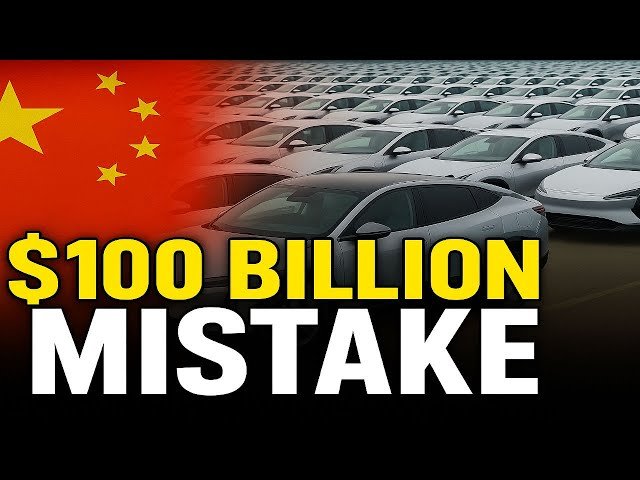
Once hailed as the crown jewel of China’s high-tech future, the electric vehicle industry is now turning into one of the most expensive centrally planned miscalculations of the 21st century. Billions in subsidies, thousands of startups, statebacked giants, all designed to crush the competition and dominate the global EV race. But now, China’s EV train is beginning to rot from within. That’s rewind the clock. In the early 2010s, the Chinese Communist Party laid out a grand economic vision. leap flocked the west in green technology by going all in on electric vehicles.
They saw it as the ultimate national project, a fusion of climate responsibility, economic modernization, and global market dominance. To make this happen, the central government is willing to roll out a jaw dropping set of incentives, cash rebates, tax exemptions, license plate privileges, and government procurement contracts. Beijing funneled over $100 billion dollar in subsidies and incentives into the industry from 2009 to 2022. If you could build an EV, even a bad one, you could get paid. That was the peach.
So, suddenly, entrepreneurs and stateowned enterprises across China began registering EV firms. Over 500 EV brands propped up within a decade. Companies that had no prior experience in automobiles were suddenly EV makers. Even property developers were getting into the game. This wasn’t about innovation. It was about capturing policy windfalls. By 2019, China produced half the world’s EVs. The state proclaimed victory. But there was one massive blind spot.
Real sustainable consumer demand. You can build the cars, you can build the plants, but can you build a market demand? Turns out not really. Most Chinese consumers still preferred internal combustion engines. charging infrastructure lagged and the vast majority of these EVs were low range low performance cars built to qualify for government subsidies not to satisfy realworld consumer needs. The real fuel behind China’s EV explosion wasn’t engineering prowess, it was subsidies. Companies learned quickly.
Success meant optimizing for subsidy collection, not for consumer satisfaction. If you could hit the right range, battery, and component requirements, you could claim cash, even if you didn’t sell the vehicle at all. This spawned perverse incentives. Some firms produced thousands of vehicles only to park them in government lots. or resell land through shell companies to create the illusion of demand. Local governments also joined the frenzy. Provincial officials under the pressure to boost GDP and employment handed out free land, low interest rate loans, and even take equity stakes in EV startups.
Some cities offer buyers thousands of dollars in subsidies, license plate privileges, a huge deal in traffic choke cities like Beijing and exclusive access to certain roads or parking spots. But the entire system become addicted to this flow of free money. When the central government began tapering subsidies in the 2020, the effects were immediate. Dozens of startups collapsed almost overnight. They had no brand, no market, and no path to profitability without government help.
Now, let’s talk numbers. In 2023, China produced 9.5 million new energy vehicles. Yet, estimates suggest that up to 3 million of those remain unsold as of early 2025. Why? Because supply has completely outpaced demand. To keep factories running and appease investors, automakers slashed prices. The result, a fullblown price war. BYD cut prices by up to 20%. Neo, Xpong, and others follow suit. Tesla too joined the frey, undercutting Chinese firms on their own turf.
Margins evaporated. Smaller players started folding. Even wellunded firms are reporting rising losses. This textbook over capacity, something China has seen before in industries like steel, aluminum, solar panels, and housing. Now again with EVs the consequences could be far worse because unlike those other sectors EVs was supposed to be China’s ticket to the golden future. You know a technology that would remake global transportation and entrench Chinese dominance in supply chains.
Instead, the industry is drowning in inventory, red ink, and broken promises. Faced with weak domestic demand, China’s automakers pivoted abroad, exports of Chinese EVs surged by 80% in 2023. Countries like Germany, France, and the Netherlands, and Thailand were flooded with cheap Chinese vehicles, often priced well below local offerings. But it didn’t take long for Western leaders to push back. In 2024, the EU launched a formal anti-dumping investigation into Chinese EVs. The Biden administration raised tariffs on Chinese EVs to 100% citing national security and unfair trade practices.
Even countries like Brazil, Mexico, and India have begun investigating Chinese EV subsidies, worried about their own domestic auto sectors being wiped out. So, this is no longer just about trade. It’s about geopolitical strategic autonomy. Western automakers have warned. If Chinese cars backed by state subsidies and industrial policy flood the market, domestic innovation will collapse. So, governments are listening and tariffs are just the beginning.
So, what happens when an entire industry backs big and loses? China’s EV crash is bleeding into every corner of its economy. Dozens of local governments borrowed heavily to attract EV startups and those debts are going bad. Thousands of workers have been laid off as startups collapse. Local banks that lend to these ventures are facing rising non-performing loans. This is all happening in parallel with China’s real estate meltdown, falling exports, and record high youth unemployment.
The EV sector was supposed to be the light at the end of tunnel, right? a new economy pillar that could offset the collapse in property and exports and heavy industry. Instead, it’s now turning into yet another bubble bursting right before the global economy’s eyes. And here’s the kicker. The most successful EV company in China is American. Tesla’s Shanghai factory opened in 2019 has become a crown jewel of its global operations. It benefited from Chinese government support, cheap land, zero tariffs, and a skilled workforce.
While Chinese startups struggled with inefficiency and weak branding, Tesla scaled production, improved quality, and even exported cars to Europe from Chinese soil. Ironically, China’s own industrial policy designed to foster national champions may have given Tesla the platform it needed to dominate uh the global EV markets. In a way, Beijing subsidized Elon Musk’s global ambitions more effectively than it supported its own firms. So, this isn’t just a story about electric cars.
It is a warning. Lesson one, central planning can supercharge industries, but it can also create massive distortions and losses. Lesson two, subsidize subsidies without accountability, invite corruption, inefficiency and failure. Lesson three, overp production kills innovation and destroys pricing power. Lesson four, exporting deflation creates geopolitical blowback. China may yet salvage parts of its EV strategy, but to do so, it must allow creative destruction, embrace market signals, and stop treating the private sector as a policy puppet. Until that happens, the EV crash will be just the beginning of a wider reckoning.
