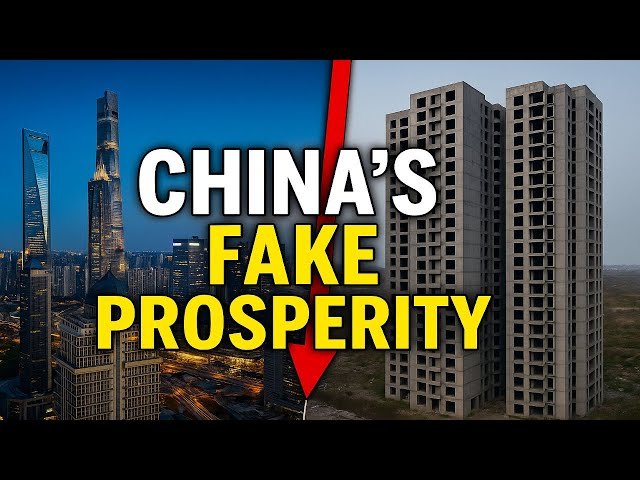
If you have ever flown into Shanghai or Beijing, you have probably thought, “Wow, China made it.” Glowing skyscrapers, bowling trains, luxury malls, an endless forest of glass and steel. But what if I told you that much of this prosperity is a lie? that behind those futuristic skylines is a mountain of unsold apartments, empty office towels, ghost cities, and banks tittering under bad debt. That what you are seeing isn’t real growth. It’s real estate disaster. In this video, I’ll explain how China built a facade of wealths to impress the world and trick foreign investors who didn’t know any better.
China’s cities are built to impress. And that’s not by accident. Since the 1990s, Chinese local governments have treated real estate as a tool of propaganda and GDP inflation. Build taller, build shinier, build faster. Foreign executives land in Pudon, drive past the glittering towels, and think this place is the future. But that’s because they never drive 30 minutes out to the outer rings of ghost developments where nobody leaves shops or works.
What they saw wasn’t organic demand. It was a government directed construction boom designed to create the illusion of unstoppable progress. Let’s be clear. Real estate is not just part of China’s economy. It is the economy. Over 70% of household wealth is in property. Developers borrowed like crazy. Local government sold land to survive. It was a self-reinforcing loop. build new towers, sell units off plan, use the cash to buy more land and repeat.
All while GDP ticks upward. The problem nobody asked. Who is going to live there? Ghost cities like Shan, empty malls in Tangan and entire apartment blocks in Zenzo with zero occupancy. Skyscrapers weren’t built for people. They were built for credit expansion. The result is not prosperity. It’s financial quicksand. So, how did so many smart foreign investors fall for the mirage? Simple. They judged prosperity by western optics. In the west, skyscrapers mean business. Clean subways mean efficiency.
High-speed rail means booming middle class. But in China, those visuals are often just that, visuals. A gleaming office tower may be 80% wakened. A luxury mall might be filled with fake tenants or subsidized rent. A new development may exist just to hit local government’s GDP quotota. Investors didn’t dig deep. They took what they saw at face value. And the CCP was happy to play along, rolling out the the red carpet, arranging photo ops and throwing around phrases like the walls uh biggest uh uh infrastructure uh producer.
But underneath there was no price discovery, no transparency, no trust in the data. Now the illusion is breaking. Ever Grande collapsed under $300 billion dollar in liabilities. Country garden defaulted. China’s banks are swimming in back loans. The once booming property market is now frozen. Buyers are not buying. Developers are not building. And local governments are gasping for revenue. In Beijing and Shanghai, skyscrapers still light up the night.
But go inside and you’ll find floors sitting empty, office listes going unrenewed, massive over supply with shrinking demand, and don’t forget the democratic time bomb, fewer marriages, falling birth rates, aging population. So who is going to fill these apartments in 10 years? This isn’t prosperity. This is a misallocation of resources funded by that expansion. China pulled off the greatest architectural illusion of the 21st century, turning concrete and steel into a symbol of progress. But now the cracks are showing.
And the question isn’t whether foreigners will fold, it’s whether the CCP fooled itself. Because you can’t build your way out of a shrinking population and you can’t inflate your way to prosperity. The debt has to be repaid. So let me know in the comments what’s the biggest illusion you have seen in China’s economy.
