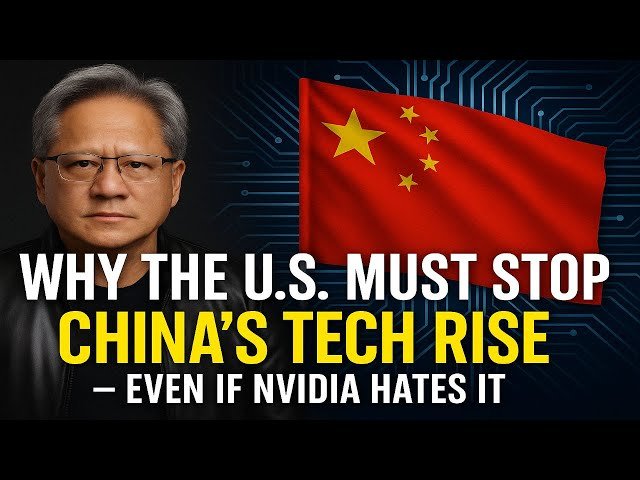
Jensen Huang, the billionaire CEO of Nvidia, says US export controls on China have failed. He’s frustrated. Nvidia is losing billions. China is developing its own chips. And his message to Washington, let us sell. But here’s the brutal truth no one in Silicon Valley wants to hear. He’s wrong. This isn’t about quarterly earnings. This is about who controls the future of artificial intelligence. If we let up now, China won’t just catch up. It could dominate the next generation of military attack, surveillance systems, and global influence.
So today we’re breaking down exactly why America must stop China’s tech rise even if Nvidia hates it. So what’s actually happening? Let’s rewind for a second. In 2018, most Americans had not heard of Huawei, let alone SMIC or Yanz memory. But inside Pentagon and across Silicon Valley, alarms were going off. China wasn’t just catching up. It was pouring hundreds of billions of dollars into dominating the technologies of tomorrow. AI, quantum computing, 5G, biotech. Then came the wakeup calls.
First, we realized Chinese firms were embedding back doors into telecom infrastructure. Then we saw how facial recognition was weaponized not just for domestic surveillance but to build the blueprint for digital authoritarianism. So, the US government responded with precision, blocked Huawei from accessing US trips, sanctioned China’s top supercomputing firms, cut off ASML’s lithography exports with help from the Dutch, and told Nvidia, “You can’t sell your most powerful chips like the A100 and H100 to China anymore.”
The goal not to China’s economy, but to ensure American innovation doesn’t fill a rival regime’s rise to unchecked power. But now, people like Jensen Wong say it’s not working, that China is still building, that the export bans are backfiring. And to be fair, some metrics look troubling. China’s chip design firms are thriving. Huawei just launched a phone using a 7 nanometer chip despite sanctions.
Nvidia sales in China has collapsed. But here’s the thing, success isn’t measured by whether China fights back. It’s measured by how much harder we make that fight. Let’s not sugarcoat it. This is not a game. This is not about beating China at export spreadsheet or quarterly guidance. This is a geopolitical arms race. But instead of missiles, we’re racing in silicon and software. Artificial intelligence isn’t just about making better Tik Tok filters or writing assays. It’s about building autonomous drones that can select targets without a human operator.
Analyzing satellite data in real time to track troop movements. Conducting psychological warfare through deep fakes and algorithmic propaganda. The exact same Nvidia trips that power chat GBT can be used to train battlefield decision engines. And who has the most data in the world? The most centralized control, the most willingness to cross ethical lines? It’s not the United States. It’s not the EU. It’s China. We’re talking
We’re talking about a regime that uses AI to assign citizens a social credit score, detains entire ethnic group based on facial recognition, and censors information information in real time across 1.4 billion people. Now imagine what that government could do with frontier AI models trained on Nvidia’s most advanced hardware. Jensen Huang is not naive. He’s one of the smartest people in tech, much smarter than me. But his job is to grow Nvidia, not to defend democratic norms or limit techno authoritarianism.
That’s why governments need to step in. That’s why export controls are necessary. This is not a trade war. It’s a digital iron curtain. And if we blink first, we lose far more than just cheap revenue. Now, let’s talk results. Critiques say, “Look, China is still producing chips. SMIC pulled off 7 nanometer. Huawei launched a phone with a domestic processor. Clearly the sanctions aren’t working. But that’s like saying someone who built a bicycle in a garage is ready to race Formula 1.
Yes, Huawei used a re advanced knot, but they did it with massive government subsidies, poor yield rates, and a supply chain held together by chewing gun and national willpower. SMIC is still stuck on DUV disography. They can’t access EUV machines. Their yields are lower, performance is behind, and cost per chip is much higher. Without ASML’s tools, without US chip design software, without access to ALM’s latest architecture, Chinese chip makers are fighting with one hand tied behind their back. Let’s not forget Nvidia’s H100 chip.
It’s 35,000 parts assembled over months using tools from 30 different countries. It’s not something you whip up overnight or replicate with patriotic slogans. In fact, the export controls are doing exactly what they are supposed to do. slowing Chinese innovation, forcing massive resource inefficiencies, making China burn time, talent, and trillions just to stay in the game. This isn’t failure, it’s friction, and friction is power.
By delaying China’s AI timeline by even two to three years, the US creates space for safer development, ethical leadership, and alliance building. Now, here’s the strategic part most critics miss. Expert controls aren’t just a hammer. They are a veg. They divide the global tech ecosystem into two spheres. On one side, democracies that protect intellectual property, value transparency, and uphold open internet standards. On the other side, a state that censors, controls, and coerces through technology.
By cutting off China, the US is forcing a realignment. And it’s working. Japan is tightening up cheap equipment exports. The Netherlands is restricting ASML access. South Korea is weighing where to link. The longer this split lasts, the more China’s tech industry becomes inwardlooking and inefficient. Nvidia may be collateral damage, but that’s a business risk, not a national one. The US government must look 10 to 20 years ahead, not just next quarter’s earnings call. Besides, Nvidia isn’t going broke.
They’re still dominating cloud enterprise and US defense. Export controls buy us time. Time to fund American fabs, train semiconductor engineers, build resilient supply chains, and shape global norms. Would you rather we just hand China the keys to the 21st century or do we draw a hard line and say no more playing both sides? If you think national security should come before temporary corporate profits, hit like, subscribe, and drop a comment. Do you think Jensen Juan is right or is the US doing the right thing by standing firm? I read every comment. That’s debate about it.
