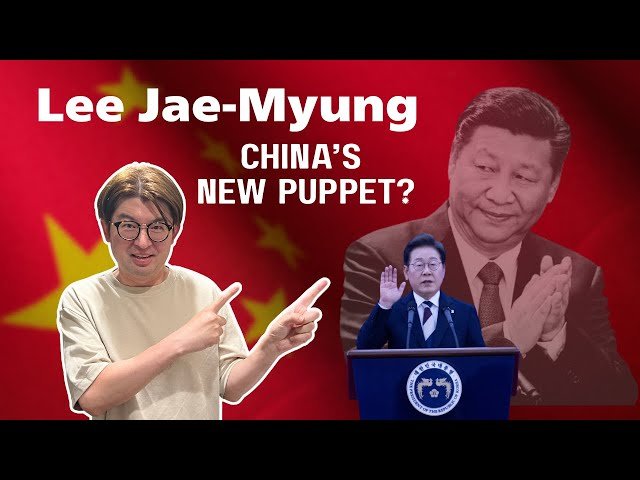
Did South Korea just elect China’s favorite puppet? That’s the question on everyone’s mind as new president Lie Jamun takes power with some very disturbing signals coming out of Soul. Look at the signs. Neutrality on Taiwan, a dream outcome for Beijing. Stoking anti-Japan nationalism, fracturing regional unity, calling for deeper economic ties with China, increasing Korean dependence, questioning trilateral security oper cooperation with the US and Japan, weakening the Indo-Pacific alliance, echoing the balance narratives that sound eerily similar to Beijing’s talking points.
Xiinping may not have voted in South Korea’s election, but he’s smiling at the result. Let’s break down the angles. First, Taiwan. For Beijing, one of the biggest prizes is driving a wedge between America’s Asian allies on the issue of Taiwan. Li Jamin has made statements about non-inference and the need for balance which in Beijing speak means don’t oppose China’s ambitions. This is dangerous. The Taiwan Strait is a critical trade uttery for Korea’s energy and tech exports.
If China takes Taiwan, its navy can project power across the entire East China Sea up to Korea’s coastline. Taiwan’s fall would also embolden Beijing to apply new economic and military pressure on Soul. South Korea’s long-term security is tied to Taiwan’s freedom. Whether Lee admits it or not, neutrality is not a safe harbor. It’s a geopolitical trap. Second, Japan. Lee is ramping up anti-Japan nationalism and dividing thefree world.
Yes, Korea has deep historical grievances with Japan. No, that cannot be the primary lens for a 21st century security strategy. Yeti Jamon is playing the anti-Japan card aggressively opposing deeper Korea Japan US military cooperation relitigating historical memory issues in ways that inflame tensions undermining efforts to create a unified Indo-Pacific democratic front. This is exactly what China wants. Beijing’s playbook is simple. Divide Korea and Japan. Prevent giant missile defense and intelligence sharing.
Keep Korea diplomatically isolated in moments of Taiwan or South China Sea crisis. Every time President Lee leans into anti-Japan populism, she wings. Third trade. Economic dependency is the soft chain of the CCP. Lee’s call for deepening ties with China is stunningly tonedeaf given what China has done to Korea before. Remember start missile crisis in 2016. Chinese state media whipped up anti- Korean sentiment. Chinese tourists stopped coming. Korean brands faced by boy boycotss and harassment.
Ly’s operations in China were decimated and Beijing is ready to do it again when never soul crosses political red lines. Yet President Lee talks about seeking balance between Washington and Beijing as if China respects balance. It doesn’t. It respects dominance and leverage and President B’s trade overtures risk putting Korea back into the dependency trap that Beijing so skillfully manipulates. Next, undermining US Korea alliance, which is another strategic gift to Shei. China’s biggest dream is a divided US alliance network in Asia.
Yet, President Lee is already questioning deeper integration with US Indo-Pacific Command, opposing trilateral military exercises that include Japan, prioritizing rhetoric about Korean sovereignty over hot-nosed security reality. This posture aligns well with China’s strategic messaging. put Korea to stay independent of US Japan frameworks. Prevent the emergence of a Northeast Asia NATO that could deter Chinese aggression. Keep so diplomatically soft on the Taiwan issue.
She knows that without Korea, the US and Japan’s containment posture is only half as strong. And let’s not forget CCP’s influence operations in Korean politics. Here’s the deeper, more subtle game. China has invested massively in Korean media influence, academia, and business elites. Many Korean conglomerates remain exposed to the China market and lobby for probe Beijing positions. Korean think tanks frequently host China funded scholars who promote balance and anti-alliance narratives.
Some quarters of the Korean press echo Beijing’s line on Japan, Taiwan, and US military presence. Li Jamun’s political brand, nationalist, economically progressive, but geopolitically ambiguous, is a perfect vector for this soft influence. He may believe he’s defending Korea’s independence, but in practice, he risks becoming the instrument of China’s divine and conquer strategy. Now, why should the world care? Because if Beijing pulls soul into its orbit, Taiwan is harder to defend.
Japan is further isolated. The court which includes US, Japan, Australia, India becomes less effective. The vision of a free and open Indo-Pacific crash and inside Korea itself, the economy becomes even more vulnerable to Chinese coercion. the political system becomes more exposed to CCP interference. The younger generation’s vision of Korea as a democratic independent actor will be betrayed. The final question we have asked is whether President Lee is deliberately trying to be China’s puppet. Probably not.
But that is the genius of soft power games. You don’t have to install a puppet. You just have to nudge the incentives until the leaders act as if they were a puppet. Right now, President Lee’s foreign policy instincts on Taiwan, on Japan, trade, and the US alliance are marching in lock step with China’s strategic interests. And unless Korea’s civil society, business leaders, and young voters push back hard, Xiinping will get exactly what he wants, a fractured alliance network. a paralyzed Korea and one more balanced voice helping Beijing reshape Asia on its terms.
So, what happens next? Let’s watch the next few months carefully. Will President Lee cave to CCP pressure on Taiwan? Will he sabotage Japan, Korea, US military coordination? Will he ignore China’s ongoing human rights abuses and regional aggression for the sake of trade? Will he allow CCP influence operations to deepen inside Korean society? Koreans and their allies need to stay vigilant. The stakes are clear. Korea can stand with its democratic allies and stay free, strong, and solvent. Or it can sleepwalk into China’s orbit just like Hong Kong did. For Koreans and their allies, now is the time to push back loudly, clearly before it is too late.
