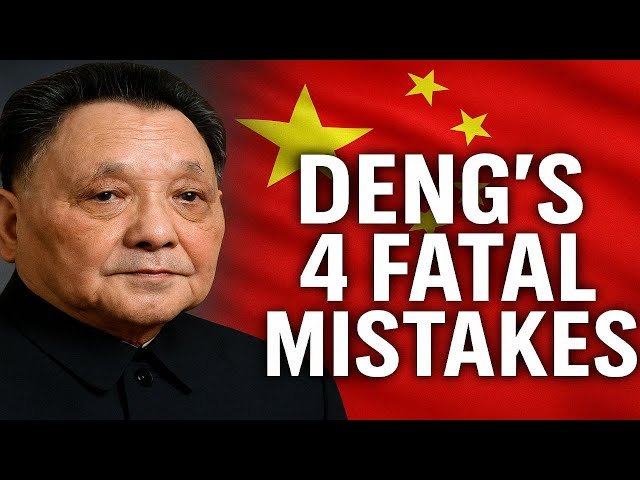
When people talk about the rise of China, they always mention Dun Xiaoing, and they should. Dun was the man who jacked China out of Mauist chaos, crushed dogma under his hill, and kickstarted one of the greatest economic boom in modern history. But here’s the part nobody wants to talk about. The same man who saved China’s economy also doomed its political future. Because while then opened markets, he locked down minds. He understood what was broken under Mao but refused to fix what would eventually break again under sheep. And that’s why today in 2025, the same system that them rebuilt is now tittering on the edge of collapse.
Let’s talk about what Dan got right and what he got tragically irrevocably wrong. First, what Den Shiaoin got right. He knew Ma’s communism was a dead end. Dan had seen it all. The great leap forward, the famines, the cultural revolution. He watched China burn from the inside. Ideology over reason, royalty over competence, chaos over order. By the time Dan cried his way back to power in 1978, he knew one thing for sure. To get rich is glorious. It was a direct rebuilt to Mauist poverty worship and ideological extremism. Then didn’t just reject Ma’s legacy, he reversed it. And that took guts. So he embraced the markets.
Even if he didn’t say it out loud, then never used the word capitalism. He didn’t have to. Instead, he gave us brilliantly subversive slogans that masked a fullscale ideological u-turn. For example, ideas like, “It doesn’t matter whether a cat is black or white as long as it catches mice. Cross the river by filling the stones that some people in China get rich first laws weren’t just slogans they were escape hatches from the economic grave Mao had created then legalized private farming allow foreign investment and that entrepreneurs build business first in Sunzen and then across the nation in under one generation he lifted hundreds hundreds of millions out of poverty.
And he did it while still waving the red CCP flag. That’s the brilliance and the curse of what then built capitalism without democracy, modernity without freedom. Also, let’s not forget that he outsmarted the West with low-key foreign policy. Duroke the West, he played them. He famously said, “Hide your strength by your time.” He downplayed China’s rights. He kept his head low. He welcomed foreign capital and that American companies in cheap labor, big profits, no questions asked. While the West celebrated engagement, Dan was buying time, absorbing knowledge, and building China’s strengths quietly.
He knew that premature confrontation would wake up the West. So he pretended China was still developing long after it had started dominating. It worked. The West gave China technology, capital, and market access. All while pretending China would one day liberalize. Then knew better. Now let’s talk about what Dan got horribly tragically wrong. For all his pragmatism and vision, Dan made four fatal mistakes and they are the reason China is now unraveling under Xiinping. Mistake number one, he refused political reform. This is the original scene. Dan fixed the economy but refused to touch politics. He loosened the leash on business but tightened the speech. He opened factories but closed off civil society. He invited capitalism in through the back door but slammed the front door on democracy.
Tiaman massacre was the ultimate expression of this refusal. When students demanded dignity, transparency and reform, he sending tanks. He purged escape erased the memory and built the next era on silence. The unspoken deal was simple. You can get rich in China, but you can never get a vote. And that deal worked until it didn’t. Mistake number two, he built growth on fear, not institutions, then created explosive growth, but without any legal or institutional foundation to sustain it. Instead of building rule of law, independent courts, transparent governance, media oversight, protections for private property, then kept all power centralized inside the Communist Party.
Entrepreneurs got rich until the party decided they were too rich. Investors thrived until the CCP rewrote the rules. Companies grew but would never truly protect it. That fear that at any moment the party can undo your success never went away. And today under she it’s all consuming. The results foreign investors are fleeing. Local officials are paralyzed. Innovation is drying up. The middle class has stopped spending. Why? Because no one feels safe in a system built on political fear instead of legal rights. Dur didn’t build institutions. He built a bonfire and lead and and she lead the fire. And uh that brings us to mistake number three.
He turned reform into a one-time miracle instead of a self-renewing system. Dun treated reform like a shock event, not a permanent mechanism. He liberalized the economy, opened markets and lifted controls once, but he never created a system of continuous feedback, adaptation or bot participation. In other words, no freedom of speech, no independent press, no academic freedom, no local elections with real power, no platform for new reformers to rise up.He thought reform could be dictated from above like a command. But real reform requires institutional renewal, checks and balances, a political immune system. So when future problems emerged like corruption, overbuilding, over reliance on real estate, the system couldn’t self-correct.
She didn’t just kill reform. He stepped into a system that was never built to evolve because Dun didn’t build a machine. He built a moment and once that moment passed, there was nothing left to protect it. Now, mistake number four, he never institutionalized the transfer of power. This one is catastrophic in hindsight. Dun was burned by Ma’s dictatorship. He knew the dangers of one man rule. So he created term limits, collective me leadership, uh retirement age norms, but he never locked any of it in black ladder law. It was all party tradition. Fragile, informal, untested. So when Xiinping came along, ambitious, looseless, paranoid, he could easily crown himself emperor without much opposition.
He just had to ignore president and nobody could stop him. Dun removed Ma’s bad policies, but he didn’t remove the system that made Mao possible. And that’s how we got she. So the collapse we see today, it started in 1989. Look around in 2025 and tell me this isn’t the end game of Dun’s model. Youth unemployment near 50%. Property markets frozen, middle class wealth erased, tax sector crushed, private capital fleeing, state paranoia intensifying, no off-ramp, no opposition, no accountability. When Jaba warned us in 2012, Xiinping proved it in the years that followed.
But the seeds were planted by Dunia in 1989 when he chose tanks over trust, fear over freedom, and power over progress. Let’s give Den some credit. He ended Maui’s madness. He opened China to the world. He lifted millions out of poverty. He saved China temporarily. But history is about consequences. And Dun’s refusal to build real institutions, allow political reform is why China never democratized. China never derisked and China today is collapsing inward. Dun built the body of a modern state. But he left the brain stuck in the 1950s.
Now that brain is cannibalizing the rest. So it’s tempting to romanticize Niaoping, but the truth is more complicated and more tragic. He was smart enough to open the window, but too scared to open the entire door. And in the end, that fear, the fear of reform, of transparency, of real democracy became CCP’s destiny. Now, as Xiinping tightens his grip, the world sees what happens when you build a superpower on sand. Den Xiaoing was a genius and Den Xiaoing built a trap. China is walking into it now.
