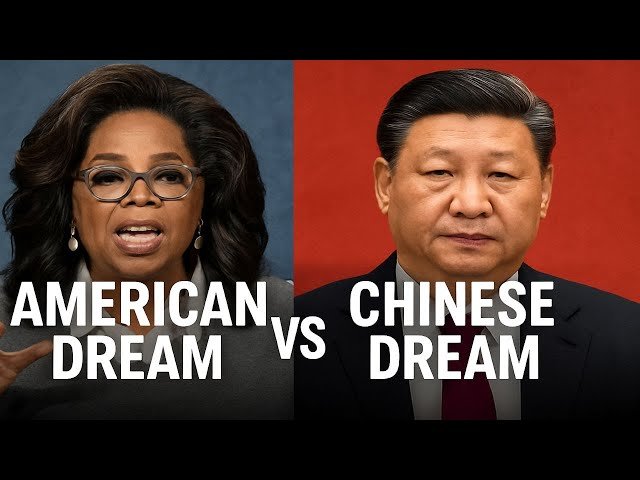
A black woman born in poverty became a billionaire media mogul. A girl from a small island in the Caribbean is now an icon in the entertainment industry. A surely Lankton war refuge ended up running Facebook’s roles and now owns part of the Golden State Warriors. That’s not luck. That’s the American dream. Now, name one weager, Indian or African immigrant who built a business empire in China. You can’t because China’s dream was never built for outsiders. In America, your past doesn’t define your future.
In China, your royalty defines your limits. In this video, we will break down the radical difference between two world defining visions. One that says be whoever you want. The other that says be exactly what we say. This is the American dream versus the Chinese dream and why it’s the most important choice of our time. First, inclusion versus nationalism. Let’s begin with what’s arguably the most defining difference. Who gets to dream in America? The answer is simple. Anyone.
You can be black, brown, white, Jewish, Muslim or Hindu. You can be poor, gay, atheist, or an immigrant with nothing but a suitcase and a wild idea. If you have drive and persistence, you are allowed to try and dream. Sanja Pichai moved from India to the US and became CEO of Google. Elang Chow, born in Taiwan, rose to the top of American politics. Sergey Brin, a Russian Jewish immigrant, co-founded Google. Elon Musk came from South Africa and changed space, energy, and automotive industries. And these aren’t cherrypicked.
You’ll find Nigerian immigrants leaving hedge funds, African women starting VC firms, Chinese Americans leaving Ivy League institutions. That’s the American dream. Now, let’s look at China. Can you name one nonh high Chinese person who has reached the top of Chinese politics, media or business with true influence? There are no veaggers, no visible Africans, no outspoken Hong Kongers, no foreignb born CEOs of major Chinese firms. The system is built for high Chinese insiders, preferably male, royal, and connected to the party.
Everyone else is a tolerated outsider at best. The American dream invites the world to participate. The Chinese dream defines your limits before you begin. Second, dream of becoming versus dream of obeying. The American dream is about becoming about transformation, reinvention, and chasing your own definition of success. Want to open a taco truck, build a gaming company, run for Congress in your 30s? It’s all up to you. In China, dreams are engineered to serve the state. School children recite party slogans.
Young people are encouraged to take safe paths. Civil service exams, stay on jobs. In America, the dream says, “What do you want to build?” In China, it says, “How do you want to serve the party?” Third, entrepreneurialship versus obedience. America idolizes the rule breaker, the outsider who defies odds and changes the game. Think about Opera who turned poverty and abuse into a media empire or Steve Jobs who dropped out of college and built Apple in a garage.
In China, entrepreneurs can soar, but only as long as they stay within boundaries set by the state. Step outside and the floor vanishes. Jack Ma was once China’s richest man. He gave a speech criticizing the financial system and vu vanished. His IPO was cancelled. His empire got it. Imagine if Elon Musk disappeared for criticizing the SEC. That’s the difference. In America, the entrepreneurial is celebrated. In China, they are tolerated until they are not. Next, open society versus closed system.
The American dream thrives because America is open to immigrants, to dissent, to chaos. It’s not always pretty, but it’s free. The press is critical. Citizens protest. Comedians mock politicians. In China, truth is dangerous. Journalists are jailed. Books are banned. The internet is censored. There’s no Twitter, no YouTube, no Google. Even memes like we need a pool are censored because they hit too close to home. In America, ideas compete. In China, ideas are filtered or erased. Next, meritocracy versus connections.
Howard Schops grew up in public housing. His father was a truck driver. He ended up building Starbucks. In America, stories like this are common enough to inspire hope, even if not guaranteed. In China, advancement is rarely about talent alone. It’s about Guangshi, connections, family ties, allegiance to party figures. The children of high high ranking officials, the princlings dominate elite roles. If you are born into power, you stay there. If you’re not, good luck breaking in.
America lets you rise. China reminds you where you belong. Next, wealth with rights versus wealth on lease. Build a business in America and your rights are backed by law. You can sue the government. You can um challenge regulations. Your property, your profits, your intellectual property, they’re yours. In China, you don’t own land, you lease it. Your company exists at the pleasure of the state. One political crackdown can wipe you out. That’s not capitalism. That’s conditional privilege.
Next, freedom versus fear. That’s not romanticized the American dream. It has flaws, inequality, racism, etc. But at its heart, it’s still driven by freedom. The freedom to speak, to build, to fail, to try again. In China, the dream feels polished on the outside. Skyscrapers, fast trains, tech parks, but it’s hollowed out by fear. Surveillance cameras track faces. The sand is crushed. Entire ethnic groups are in interned. Hong Kong’s free press gone. A dream built of fear isn’t a dream. It’s a quiet nightmare. The American dream is loud, messy, and still one of humanity’s greatest ideas. It dares you to be more, to break rules, to dream without permission. The Chinese dream may build cities overnight, but it cannot build people who are truly free.
