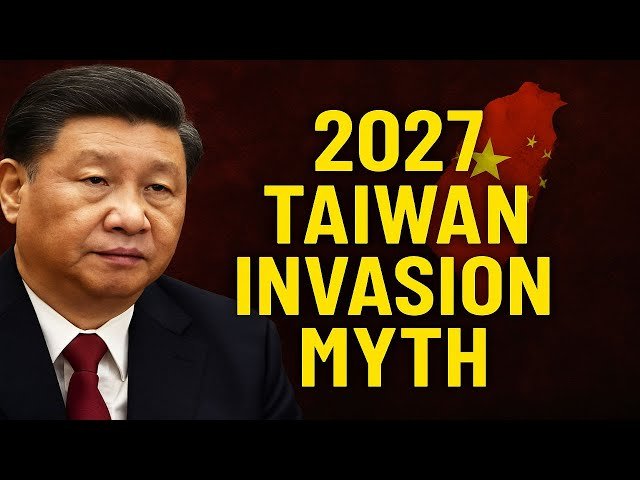
So, is Xiinping really about to invade Taiwan? A closer look at the military purge inside China will reveal the answer. One of the most common concerns I hear in response to my recent video about why Taiwan is one of the most overlooked investment opportunities in Asia. Is this isn’t Taiwan too risky? Won’t Xiinping invade any day now? I get it. The fear of a Chinese military invasion looms large over any discussion of Taiwan’s future, especially for uh investors. So why put money into a country that could become the next Ukraine? But here’s the thing.
The surface level narrative that Xiinping is on an unstoppable march to take Taiwan by force ignores the internal chaos unraveling inside China’s military. And let’s talk about the unprecedented purge of top generals within the People’s Liberation Army, PLA, and what it really means for she’s ability and willingness to launch a war across the Taiwan Strait. First, the 2027 Taiwan invasion deadline myths. Let’s start with the 2027 date that keeps getting thrown around.
Some analysts claim that Xiinping has given the PLA until 2027 to be ready to take Taiwan by force if necessary. This idea has created panic in geopolitical circles and sparked countless headlines speculating about imminent war. But here’s the question nobody asks. What condition is the PLA actually in right now? If you look beyond the military parades and propaganda videos, what you will find is the military undergoing one of the most aggressive internal purges in modern
Chinese history.
One that suggests Xiinping does not trust the very generals who are supposed to lead this war. In the last year, a wave of highranking PLA officers have either disappeared from the public view, been demoted, or are rumored to have been detained or investigated. These aren’t low-level officials. They are Xiinping’s own men, the generals he personally promoted, entrusted with major military roles. Take Hi Dong for example, the second most powerful man in the PLA and vice chairman of the Sancho military commission.
He was deeply involved in Taiwan invasion planning and served as a core architect of the PLA’s combat scenarios for uh amphibious assault cross street. Now he’s gone. Other top figures like uh Hong Jin and Mia have also vanished or are reportedly under investigation. These men weren’t just military administrators. They were involved in morale, ideology, political royalty, and human resources for the armed forces. They were the the group that kept the system together. and she’s campaign to root out disloyalty and corruption in the upper ranks of the PLA has created a climate of fear.
Generals now know that getting too powerful, too visible, or even too effective can be a career ending or lifeending mistake. And this matters for one simple reason. You can’t start a war when you don’t trust the people supposed to fight it. The removal of senior officers, especially those tasked with Taiwan related operations, raises a red flag, not just about military readiness, but about Xiinping’s personal confidence in the institution that he commands.
Think about it. If she was truly gearing up for war, would he be purging the architects of that war plan? Or is it more likely that she’s deeply insecure about what his military is telling him that he’s worried that they have been feeding him overly positive and optimistic projections or worse lying outright about the PLA’s readiness to take on the US, Japan, and Taiwan’s advanced defense ready forces. It’s also likely that she suspects some of his generals are more loyal to their own internal networks than to him personally.
That’s a major problem in a system where trust is everything. And she’s regime is built not on merit but on royalty. Um and another key point often overlooked in western commentary is that Xiinping is not a risk taker by nature. He’s a control freak. Every major move he has made from anti-corruption crackdowns to draconian COVID lockdowns to the tax sector’s crackdown has been about tightening his grip on power. War, especially war against the US backed Taiwan, is the one thing she cannot control once it starts. It’s not like cracking down on Jack Ma or censoring social media.
The war is messy, unpredictable, and carries real risks of humiliation or escalation. And right now, the PLA is plagued by scandals, power struggles, and internal distrust. You know, its top ranks are under surveillance, its meat level officers are watching their backs, and the rest of the force is demoralized by the atmosphere of purges and paranoia.
So, would you bet your legacy on that army? No. And neither will she. At least not now. So what this means for Taiwan and for investors, let’s circle back to the original concern. Is Taiwan too risky to invest in because of the threat of war? The answer is no. In fact, the threat of war, while real, has arguably decreased in a short to medium turn precisely because of what’s happening inside the PLA. She’s iron grip on the military has created a uh brittle command structure where no one dares to act decisively and everyone is afraid of being the next target to fall.
Launching an invasion under lead’s conditions would be not just reckless, it would be suicidal for she’s rule. And if there’s one thing we have learned about she over the last decade, it’s that he will always choose power preservation over ideological crusades. Yes, Taiwan will always face pressure from Beijing. Yes, tensions may flare, but invasion is not imminent. And the deeper story unfolding inside China’s military suggests that she may be further from launching a war than he has ever been before.
For investors, this means something important. Don’t mistake headlines for strategy. Taiwan’s economy, companies, and capital markets are still operating at full strength. The ideological noise is loud, but when you look closer, the fundamentals remain sound and the invasion narrative, while emotionally powerful, doesn’t match the reality inside she’s own war machine. If you really want to understand where the war is coming, don’t just watch what she says about Taiwan.
Watch who disappears. Uh when generals vanish, it doesn’t mean war is coming. It means she is still cleaning house, still trying to build an army he can trust. Until that job is done, it’s highly unlikely he’ll risk rolling a dice on Taiwan. So yes, Taiwan is investable. In fact, it may be one of the most mispriced opportunities in Asia today precisely because fear has blinded people to the facts. As always, um do your own research, but dig deeper than the headlines, and that’s where the truth hides.
